
Annual Budget Report
Understanding Medical Lake's
Annual Report
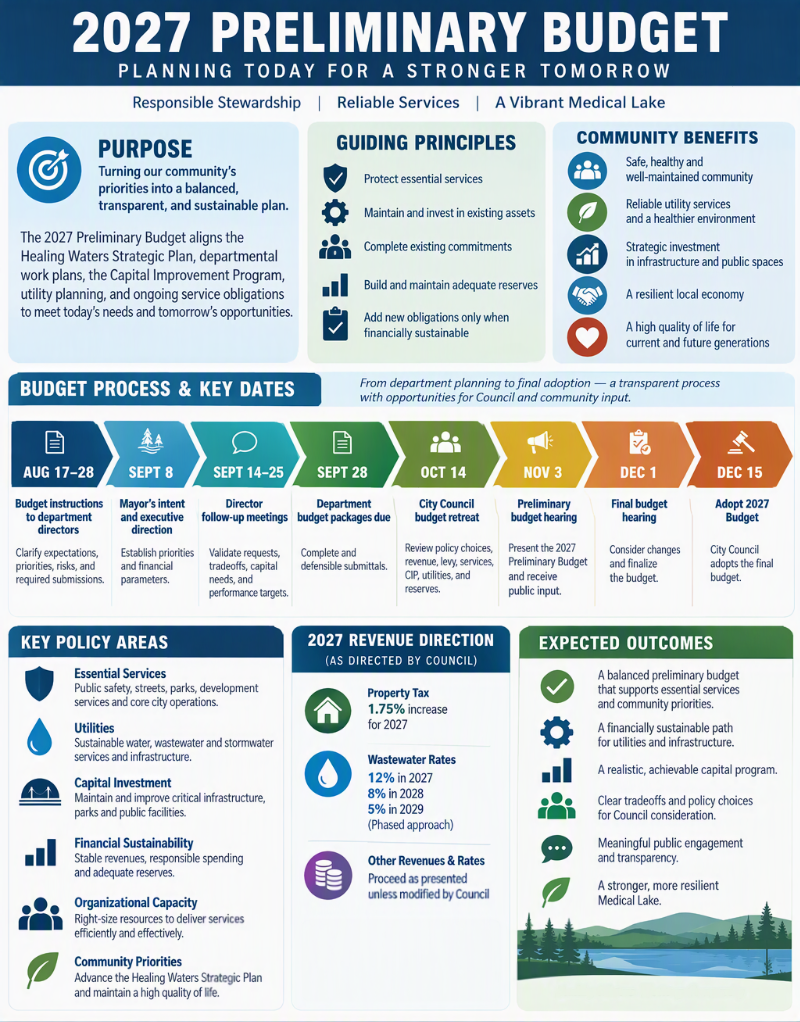
The City of Medical Lake’s annual budget is more than a financial document – it is the City’s plan for turning community priorities into services, projects, and results. Each year, the budget connects the Healing Waters Strategic Plan, department work plans, staffing, infrastructure needs, utility operations, capital projects, grants, revenues, and reserves into a financially responsible plan for the year ahead.
Ultimately, the budget establishes what services the City will provide, what projects it will pursue, how available resources will be used, and what financial reserves will be maintained. After adoption, the City monitors revenues, expenditures, capital projects, grants, and departmental work throughout the year and reports financial results to Council.
In simple terms, the annual budget process answers four important questions:
Where does the money come from?
What will it pay for?
How are priorities chosen?
When can the community have a voice?
Start
Start
The process begins with a review of the City’s financial condition, strategic priorities, existing commitments, and anticipated revenues.
Departments then identify service needs, priorities, staffing requirements, capital projects, and other resources needed for the coming year.
The Mayor, City Administrator, and Finance Director review these requests and develop a preliminary budget for City Council consideration.
Council reviews the budget through the budget retreat, workshops, revenue and property-tax discussions, and public hearings.
Residents can follow the process through Council materials and livestreams and can provide input through written comments, remote participation, and public hearings before the final budget is adopted.
Finish
Finish
The Final Budget is adopted
Frequently Asked Questions:
What is the City budget?
The legal and financial plan for City services and projects for one calendar year.
Why adopt it annually?
State law requires an annual code-city budget unless a biennial system is adopted.
Who proposes it?
The Mayor’s recommended budget is assembled with the City Administrator, Finance Director, and department heads.
Who adopts it?
City Council, by ordinance after public review.
What is the budget retreat?
A working session where Council reviews services, results, staffing, capital needs, rates, and longer-term effects.
What is the General Fund?
The primary operating fund for resources not required to be recorded elsewhere.
What are special or restricted funds?
Funds whose money is legally or formally limited to particular purposes.
What are enterprise funds?
Utility-type operations funded primarily by customer charges.
What is the Capital Improvement Plan (CIP)?
A multiyear plan for major facilities, streets, parks, water, sewer, and equipment investments.
Are CIP projects automatically approved?
No. Funding, design, grants, contracting, and annual appropriations may require separate actions.
Why keep reserves?
For cash flow, emergencies, infrastructure replacement, grant matches, and financial stability.
Where does revenue come from?
Taxes, service charges, utility rates, fees, grants, state-shared revenues, investment earnings, and available balances.
Can grant money pay for everything?
No. It must follow the grant agreement and authorized purpose.
How is staffing considered?
Departments identify service needs, capacity, compensation, and recurring costs for review.
Why are utility rates separate?
Water, wastewater, and solid-waste costs are evaluated as service operations and adopted by Council resolution.
How does property tax fit?
Council holds a revenue hearing before adopting the levy; an increase must be specifically authorized.
Preliminary versus final budget?
Preliminary means proposed and open to revision; final means the version Council adopts.
How can residents comment?
Written comments before meetings, remote participation, in-person testimony, and public hearings; livestreaming is available for viewing.
Can the budget change later?
Yes, through a lawful budget-amendment ordinance.
How is it monitored?
State law requires at least quarterly status reporting; the recommended City format also tracks projects and service outcomes.
What are 2027 adopted outcomes?
Final figures will be published after Council action.